

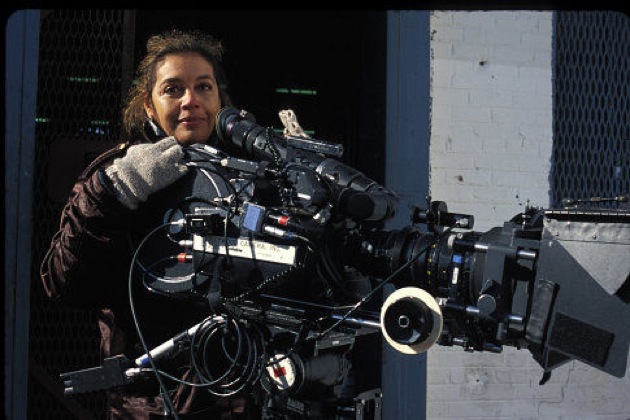
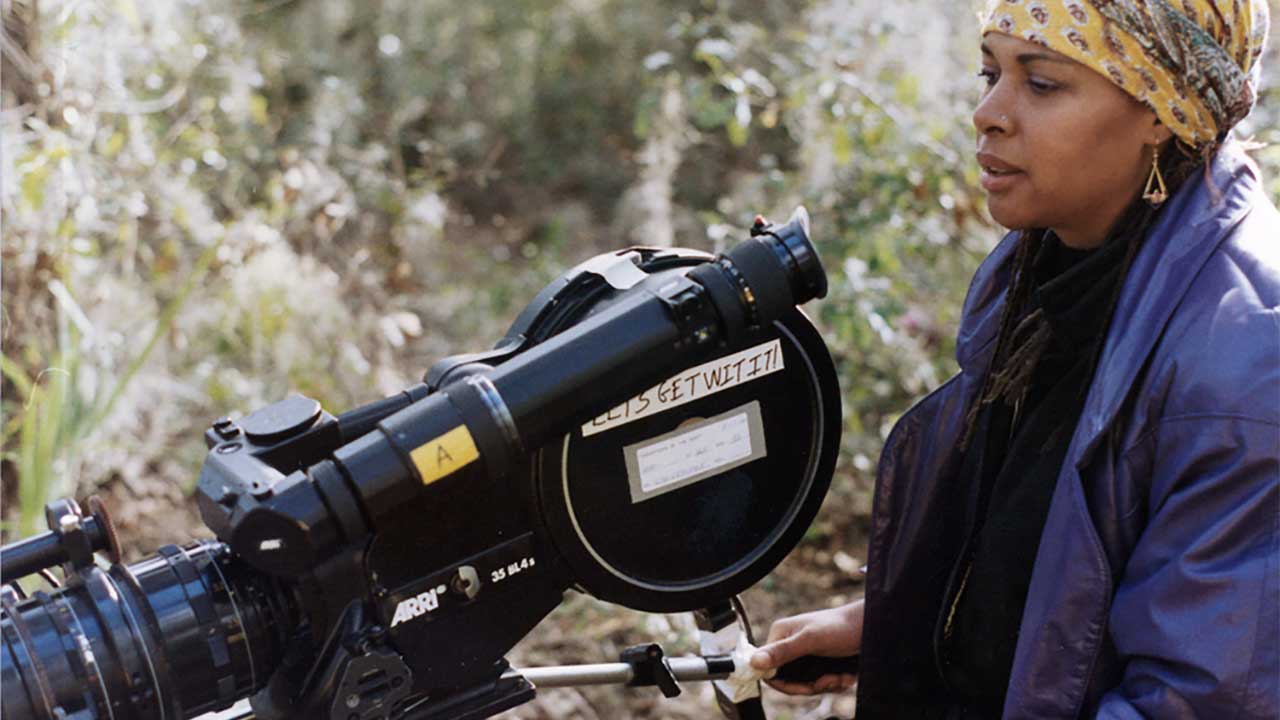
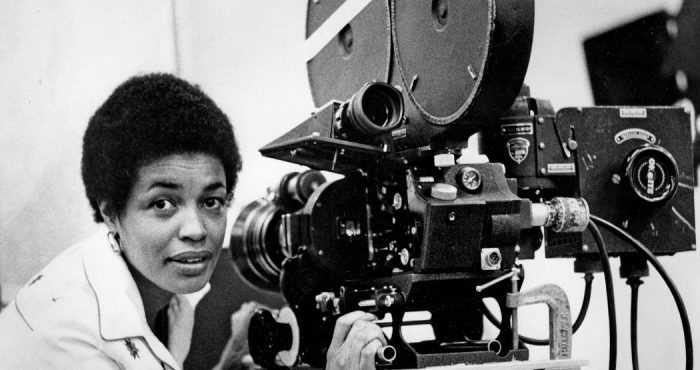
Troy Beyer: Filmmaker
Troy Beyer: Turn of the Century Trifecta Phenom
Actress, Writer, Director: Active 1968-2007
I. Biography
- Born in New York City to an African American mother and a Jewish father on November 7, 1964
- Raised primarily by her mother and grew up living next door to dance choreographer Alvin Ailey, founder of the Alvin Ailey American Dance Theater who encouraged her into performance arts

- At age four, she began her acting career with a role on the children’s program Sesame Street, which she credits as her first foray into understanding the world behind the camera. She worked on the show for seven years
- In 1984, Beyer got her first taste of feature-length cinema when she landed a small role in Francis Ford Coppola’s Oscar-nominated production, The Cotton Club, starring Richard Gere and Laurence Fishburne
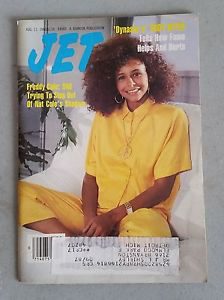
- In 1986, after a rough transition to Los Angeles (living in Salvation Army facilities and various foster homes), Beyer became a regular on ABC-TV’s primetime hit soap opera, Dynasty, playing notable character Jackie Deveraux
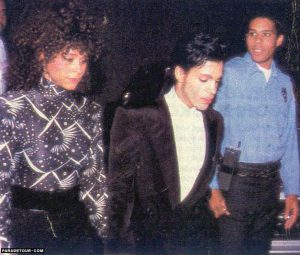
- Appeared in Prince’s music video for his hit song, “Sexy MF”
- Over the years, Beyer has acted in numerous features including Weekend at Bernies II (1993), Eddie (1996) starring Whoopi Goldberg, Robert Altman’s The Gingerbread Man (1998) starring Robert Downey Jr., and John Q (2002) starring Denzel Washington
- In 1997 she made her screenwriting debut with B.A.P.S., starring Halle Berry, Martin Landau, and Natalie Desselle Reid
- In 1998, she directed and starred in her next screenplay, Let’s Talk About Sex
- Credited as a co-writer on Love Don’t Cost a Thing (2003) starring Nick Cannon and Christina Millian
- After a lifetime of yearning to become a doctor and scholar, she completed her master’s degree in Depth Psychology with an emphasis in Liberation, Community, and Eco-Psychology and went on to receive her doctorate in Clinical Psychology (she occasionally moonlights on the Steve Harvey show as a relationship expert)
- She authored an Amazon Best-Selling self-help novel entitled “Ex-Free: The Freedom Action Plan”
II. An Exploration of The Life & B.A.P.S, The Tide-Turner
In the world of cinema, it has been a longstanding tradition that the realms of acting, directing, and writing remain mutually, although rather precariously, distinct. Indeed, as history demonstrates, show business has a definitive inclination to want to categorize artists into singular modes of activity and construction in such ways as to make the notion of successfully establishing a career of plurality seem almost impossible. However, to complicate this resolute matrix of ideology, what if we added race and gender politics to the mix? Furthermore, what does the equation look like if we posit ourselves yet again at the turn of the 21st century before the swell of technology and information-sharing? Long story short, it’s easy to see that the odds were far from the favor of New York City-bred actress, writer, and director, Troy Beyer. Born to a black mother and a Jewish father who remained somewhat absent from her childhood, Troy began her media career at the ripe age of four in 1969 as a regular on the children’s smash hit television show, Sesame Street. Encouraged at the bequest of her neighbor, up-and-coming world-famous dancer Alvin Ailey, her mother fostered and upheld her participation in the production for seven years. A few short years later, she transitioned to Los Angeles where, after a stint of living in foster homes, she landed a large role on the primetime ABC soap opera, Dynasty. Years passed and she acted in a series of feature films with big names attached, including John Q with Denzel Washington (2002) and The Cotton Club (1984) directed by Francis Ford Coppola. She even made an appearance in a few music videos, including Prince’s “Sexy MF” and Biz Markie’s “What Comes Around Goes Around.” Beyer enjoyed acting, but after many debilitating years of waiting on principal roles and feeling creatively subjugated, she made a major decision to begin writing her own stories and authoring her own content.
https://www.youtube.com/watch?v=cHPpnwYVV8s
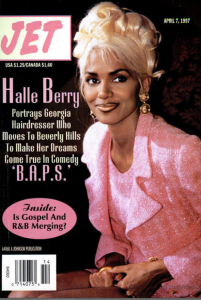
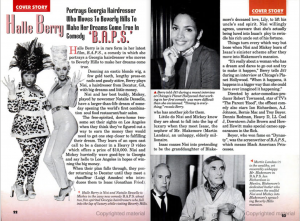
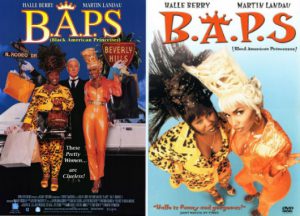
In 1997, Troy Beyer shocked us all with B.A.P.S., a feature-length comedy starring Halle Berry and Natalie Desselle Reid that marked her first and formal entree into the world of screenwriting. The script, which is on record in the Margaret Herrick Motion Picture Arts Library in Beverly Hills, California, is recorded as being first published in April of 1996, but the manuscript also contains traces of approximately eight subsequent revised versions of the narrative. B.A.P.S. tells the story of two Georgia waitresses who decide to leave behind their lackluster lives when they hear about a video dance competition with a big cash prize in Beverly Hills. The film is a story about following dreams and defying the odds, something we can only imagine that Beyer knows about particularly well. However, beyond this reading, one can’t help but notice that it’s a film built on establishing connections and bridging gaps of understanding and difference—whether across bounds of race, class, gender, or occupation. 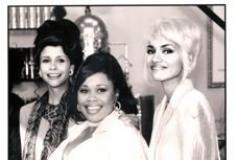
Despite existing as a rather contentious film for almost two decades now, B.A.P.S. was absolutely crucial to Beyer’s career and development not only as an artist, but also as a media auteur. However, before delving in how this film altered her creative trajectory, it’s important to break down more of the film’s nuts and bolts and explore how it was received. The story of B.A.P.S. gained its momentum from ostensible situational comedy and utilization of hyperbole to poke fun at presumably “ethnic” stereotypes. By sheer virtue of the shift in settings from the graffiti-ridden, urban, diverse streets of Georgia to the crisp, stark, white avenues of Beverly Hills, it stands to reason that the film derives humor from its positing of these two environments as being polar opposites. In fact, the narrative as a whole relies heavily on the trope of pitting such ideologically polar opposites against each other across binaries of race, gender, geography, and class. If we consider the tally, we see that Beyer sets the stage such that black appears in opposition to white, female stands opposite male, poor shrinks in awe before rich, and Georgia’s lively streets are forgone for California’s literal greener grass. https://www.youtube.com/watch?v=K5rHul24rqE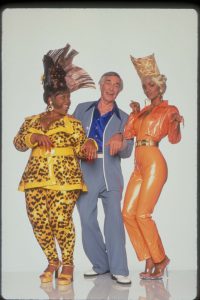
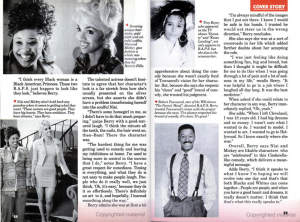
Although these elements are clearly at play in the background of the script, she foregrounds her narrative with two enthusiastic protagonists whom, in taking off to pursue their dreams, are able to eventually navigate between these opposite worlds and delight us with their uncanny behaviorisms and inept yet blissful candor. The film, which was directed by Robert Townsend (of Hollywood Shuffle fame), premiered on March 28, 1997, across 1,204 screens in America. Even though the budget was roughly ten million dollars, the film only made a fraction of this back during the first month after opening. An appropriate conclusion one might draw from this financial failure was that the film was generally disliked and/or ill-received. And lo and behold, the witch hunt began to single B.A.P.S. out as a cinematic disaster. Critics, such as Roger Ebert of Rotten Tomatoes fame, commented:
“B.A.P.S.” is jaw-droppingly bad, a movie so misconceived I wonder why anyone involved wanted to make it…Berry and Desselle Reid play vulgar and garish homegirls from Decatur, Ga., whose artificial nails are 8 inches long, whose gold teeth sparkle, and whose hairpieces are piled so high on their heads that the concept passes beyond satire and into cruelty.”
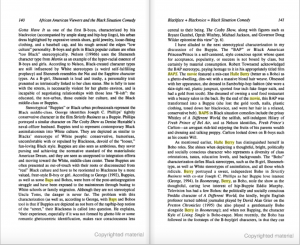
Meanwhile, writer Robert R. Means Coleman in his book titled African American Viewers and the Black Situation Comedy: Situating Racial Humor, likens the depictions of the title characters Nisi and Mickey (Berry and Desselle Reid respectively) to modern day blackface. In his chapter exploring how notions of blackness are understood, constructed, and upheld by geography (i.e. true blackness as being a function of the “ghetto”), he asserts that B.A.P.S. exploited a specific cultural phenomenon for the sake of harnessing this comedic niche. He states,
“The ‘BAP’ or Black American Princess/Prince is a self-centered, style conscious egoist whose quest for acceptance, popularity, or success is not bound by class, but certainly by material consumption. Robert Townsend acknowledged the BAP stereotype, paying homage to it in his appropriately-titled film BAPS. The movie featured a miscast Halle Berry as a ghetto-dwelling, dim-wit with a massive blond hair weave. Obsessed with her appearance, she dressed in Sambo/hip-hop fashion (she wore a skin-tight red, plastic jumpsuit, sported four-inch fake finger nails, and had a gold front tooth).”
However, even though Coleman and Ebert seem to tear the film apart largely based off character aesthetics and performance choices, one finds it hard to dismiss a film just because its main hustle is delivering comedy packaged in the vehicle of recognizable cultural phenomena and archetypes. On one hand, it is clear—given the extent to which Nisi and Mickey are painted as caricatures—that they are not to be trusted as clear reflections of a given hypothetical society. They are outliers in the way that the genre of comedy requires them to be: familiar, but hopelessly flawed to the point of excess and implausibility. And when we are able to drop these guards and reservations about the politics of representation, perhaps there is a chance to appreciate how Berry never seemed to break a sweat despite wearing a plastic suit during a Los Angeles summer, or that Desselle’s glowing, sky-high hairpiece marked a cinematic feat we never imagined possible. Or even, and perhaps most importantly, that two girls from the proverbial “wrong” side of the tracks manage to create a place for themselves in the world of their dreams. 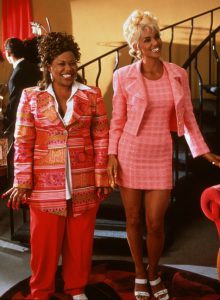
All in all, these considerations aside, numbers show that the film didn’t do well with audiences on the theater circuit. However, complicating this generally disappointing reception was the fact that Beyer herself didn’t even want to claim the work as her own after its release. According to her, the project was a train that seemingly ran off the rails. In a retrospective interview with IndieWire she states:
“I had written a film called B.A.P.S. When I saw the final cut, I was so devastated because I really believed that my words had not honestly made it onto the screen. The director was a writer/director himself and it was the first time he had directed someone else’s writing. He took the liberty of changing stuff as he shot the film. At the end of the day, when I saw the film, I hated it. I was really embarrassed and it was too late for me to take my name off the picture. Then I got killed by the critics. Me! The writer! I just thought I’m gonna take the money from this awful experience and put it into my own film. I’m gonna direct it and make sure my words make it to the screen. If the critics try to kill me now, there’s nothing they can say that’s gonna hurt me because I know that I did my very best. Those are my words on screen and I stand by them. So, I took the money from B.A.P.S to make my movie.”
There can be little confusion as to her feelings about the film given this statement. Clearly, she found it to be a perversion of her intended exploration so much so that she vowed to direct her next screenplay in the hopes that such a grave miscalculation of intent could not occur twice. It was this censure and disdain from critics and audiences alike that prompted Beyer to yet again reevaluate her career choices and scope.
After seeing how her script could be distorted as it cycled through the natural phases of production, she realized that merely authoring a script would not ever truly be enough to fully realize the visions that she could proudly and rightfully call her own. So, with this in mind, she wrote, directed, and handled the initial marketing and distribution of her next film, Let’s Talk About Sex, that was released in 1998 after premiering at Sundance Film Festival. Unlike the broad and spirited comedy that seemed to simultaneously both damn and give life to B.A.P.S, Let’s Talk About Sex was a more earthy, thoughtful exploration about intercourse and female sexuality.  Instead of the heightened performance and aesthetic commentary of her last script, she imbued this project with more naturalism and sincerity as she endeavored to unravel the seldom-traversed territory of female pleasure. This film was made for a budget of roughly $300,000, but Beyer succeeded in selling the project for almost four million dollars. And even though she faced some difficulty with the MPAA in censoring of some of the content, she was able to walk away from this project knowing that it was hers.
Beyer is an important figure in the canon of black female authors because she managed to resist the pressure to categorize and box herself in as a one-dimensional creator. It’s both intriguing and inspiring to contemplate her ability to deftly weave for herself a tapestry of fluidity in which she has been able to partake in whatsoever role she so desired in the making of a film. From a successful career as an actor to a daring breakout as a director and writer, Beyer is a true Renaissance woman who proves that you truly can have it all. Much like her romantic characters in B.A.P.S., she is a woman who forged her own path through Hollywood and when the game got rough, she changed the rules and redefined the field. After this incredible journey, Beyer has continued to write, direct, and appear in film and television. Amplifying this star power with scholastic power, she received her doctorate, published an Amazon Best-Selling novel, and currently moonlights on The Steve Harvey Show as a relationship expert.
Links For Your Consideration:
1.) Black Hollywood Live’s Interview with Troy Byer: https://www.youtube.com/watch?v=5fCI2BF_nPk
2.) Behind the Scenes look at Beyer’s film “Ex-Free”: https://www.youtube.com/watch?v=r58zktGthsI
3.) Troy Beyer Rocks Indie Power TV: https://www.youtube.com/watch?v=moEzEbWJq7k
Works Cited:
1.) B.A.P.S. Dir. Robert Townsend. By Troy Beyer. Perf. Halle Berry, Martin Landau, Natalie Desselle Reid. New Line Cinema, 1997. Film.
2.) Beyer, Troy. American Princess Inc. 1996. TS, Screenplays, Scripts, Transcribed Copies. Margaret Herrick Library of Motion Picture Arts & Sciences, Los Angeles.
3.) Coleman, Robin R. Means. “Blackface + Blackvoice = Black Situation Comedy.” African American Viewers and the Black Situation Comedy: Situating Racial Humor. New York: Garland, 2000. 141. Print.
4.) Cunha, Tom. “Actor-Director Troy Beyer Talks About Sex.” IndieWire. IndieWire, 14 Sept. 1998. Web. 30 Mar. 2017.
5.) “Halle Berry Portrays Georgia Hairdresser Who Moves to Beverly Hills to Make Her Dreams Come True in Comedy B.A.P.S.” Jet 7 Apr. 1997: 22-25. Google Books. Web. 30 Mar. 2017.
6.) Owens, Donna M. “One Door Closes for Troy Beyer, Another Opens.” Tribunedigital-baltimoresun. Baltimore Sun, 11 Dec. 2003. Web. 30 Mar. 2017.