
Julie Dash
The Collectivism of Daughters of the Dust
A Closer Look at the Art and Design Aspects of the Celebrated Film

Image Courtesy of JulieDash.tv
Julie Dash is constantly referred to as ahead of her time. With the success of her landmark 1991 film Daughters of the Dust, Dash became the first black woman to direct a feature length film with a wide release. Since then, artists like Ava DuVernay, Issa Rae, and Gina Prince- Bythewood have followed in her place. DuVernay has publicly bemoaned her own race related career milestones citing Dash as someone who could have easily done the same if only she hadn’t been “ahead of her time.” Dash has since worked on several projects including Love Song (2000) The Rosa Parks Story (2002), and the upcoming Travel Notes of a Geechee Girl (2017). Still, Daughters of the Dust will forever stand out as the film that changed the game.
With the help of a stellar team of artists, Julie Dash recreated the lands of the Gullah to tell the story of one family wrestling with the fundamental question: should we stay or should we go? Daughters of the Dust details the lives of several Gullah women grappling with ancestral definitions of family and self in an ever changing spiritual and geopolitical landscape. In a story rooted in universal familial struggles of who’s right and who’s wrong, Dash transposes the past onto the present, following the Peazant family as they welcome prodigal daughters and negotiate difference.
Daughters of the Dust was placed in the National Film Registry by the Library of Congress in 2004 and has won countless awards and nominations. The film was the very first feature film by an African American woman to have a wide theatrical release, and it spectacularly outperformed its meager $800,000 budget. Dash’s masterpiece has received new found attention in the wake of its 25th anniversary.
Link 1: Here is a brief interview about the making of Daughters of the Dust. Julie Dash reveals her narrative goals for the film, and her reasoning for choosing the sea islands as a point of exploration.
Julie Dash speaks frequently on how her film made a name for itself in a 20th century black cinematic zeitgeist mainly consisting of urban tragedies. Dash has since referred to her film as a foreign piece of cinema. When speaking to Rolling Stone about the film, Dash recalled the dearth of stories that prompted her to create Daughters. “I really wanted to see an African- American historical drama that took me places that I had never been to before…just like I was taken places when I was watching foreign films or even some American epics. Films I was seeing at the time weren’t really made for African-Americans — they were made to explain our history to others” (Grierson). Dash has since praised Kino International for seeing Daughters of the Dust for what it was back in 1991, “a foreign film”, and distributing it.
Link 2: Here is an interview Dash conducted with Melissa Harris Perry and Elle Magazine about the 25th Anniversary of Daughters of the Dust and her goals as a filmmaker: http:// http://shadowandact.com/2017/01/02/watch-melissa-harris-perry-interview-julie-dash-about-daughters-of-the-dust-and-other-things/
Dash’s film falls in line with a host of other productions stemming from the LA Rebellion that sought to showcase varying iterations of black life across the globe. Filmmakers like Haile Gerima (Sankofa, 1993), Zeinabu irene Davis (Cycles, 1989), Charles Burnett (To Sleep with Anger, 1990), and Monona Wali (Grey Area, 1982) gave voice to a chorus of histories that had been silenced for far too long. The focus of the LA Rebellion was to shed light on stories previously untold for culturally calculated reasons.
Author and film historian, Kara Keeling, recounts the doctrine of the film focused group in her compilation, The Witch’s Flight. “Accountability to the black community is more important than training to be incorporated into a racist film industry; that the destiny of black people is the proper concern of this group’s work, not ‘self-indulgent assignments about neurotic preoccupations’; and that among their tasks is that of recreating cultural memory, a task that leads them to unearth and re-present suppressed black literature, lore, and history” (Keeling, 52). A culture of collectivism and specificity in storytelling is key for artists like Dash who seek to tell stories that have previously been denied the privilege of being told. Most notable in her quest for authenticity is the network of artists and activists that made up Dash’s art design, production design, and costume design teams.
While the subject matter of her 1991 film is rightfully heralded as revolutionary, an equally important aspect of Julie Dash’s memorable film is the iconography that came with it. Costumes, hairstyles, indigo dye beds, graveyards, and other pieces hold weight in a very special way in this film. Through analyzing a set of artifacts such as interviews, photographs, and press materials, I’ve concluded that a collaboration rooted in specificity, not convenience, was the lifeblood of films like Daughters of the Dust.
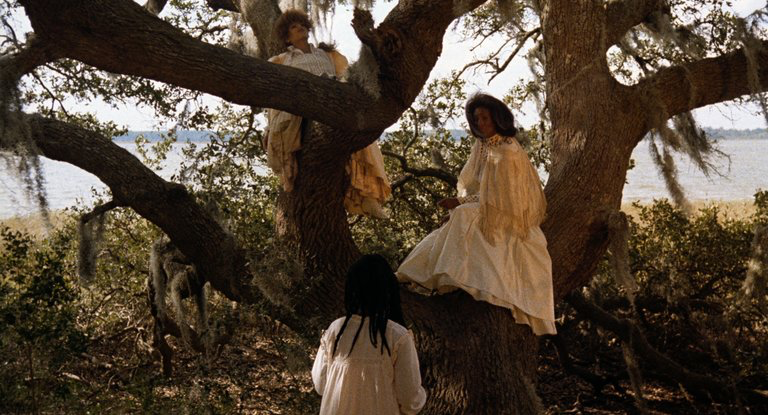
In his 1992 review of Dash’s feature film directorial debut, Stephen Holden of the New York Times called it “a film of spellbinding visual beauty.”
“For all its harsh allusions to slavery and hardship, the film is an extended, wildly lyrical meditation on the power of African cultural iconography and the spiritual resilience of the generations of women who have been its custodians” (Holden). Nearly every review of the film at the time of its release praised Dash’s lyrical storytelling and her film’s striking visuals.
For the film’s 25th anniversary restoration, Cohen Media Group distributed it, placing Daughters of the Dust back in theaters for a next generation of moviegoers to enjoy. As a part of the media collective’s press kickoff, Dash continued to outline her goals as a storyteller in regards to visual representations. Evidently one of Dash’s goals was to produce a “historically authentic, low-budget film, saturated with the visual arts of West Africa and its Diaspora” (Cohen Media Group).
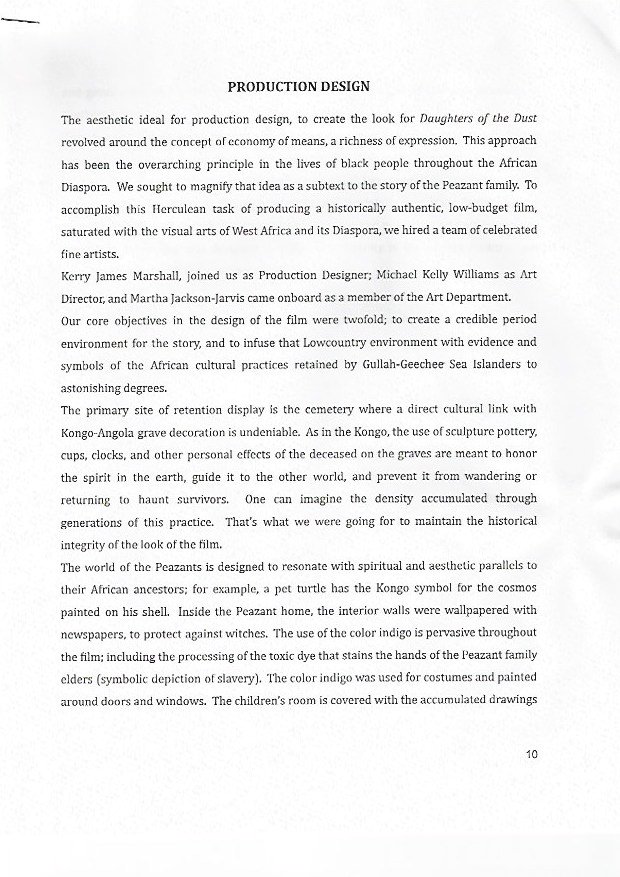
Scanned Document 1: Cohen Media Group Press Materials, Julie Dash’s Production Design. Image Courtesy of the Margaret Herrick Library Reference and Research Collection, 2016
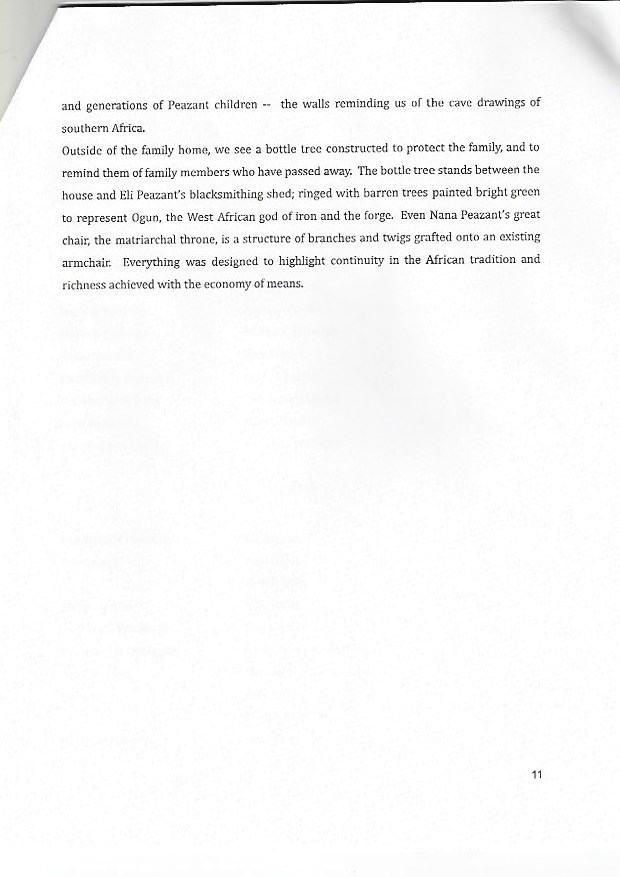
Scanned Document 1: Cohen Media Group Press Materials, Julie Dash’s Production Design. Image Courtesy of the Margaret Herrick Library Reference and Research Collection, 2016
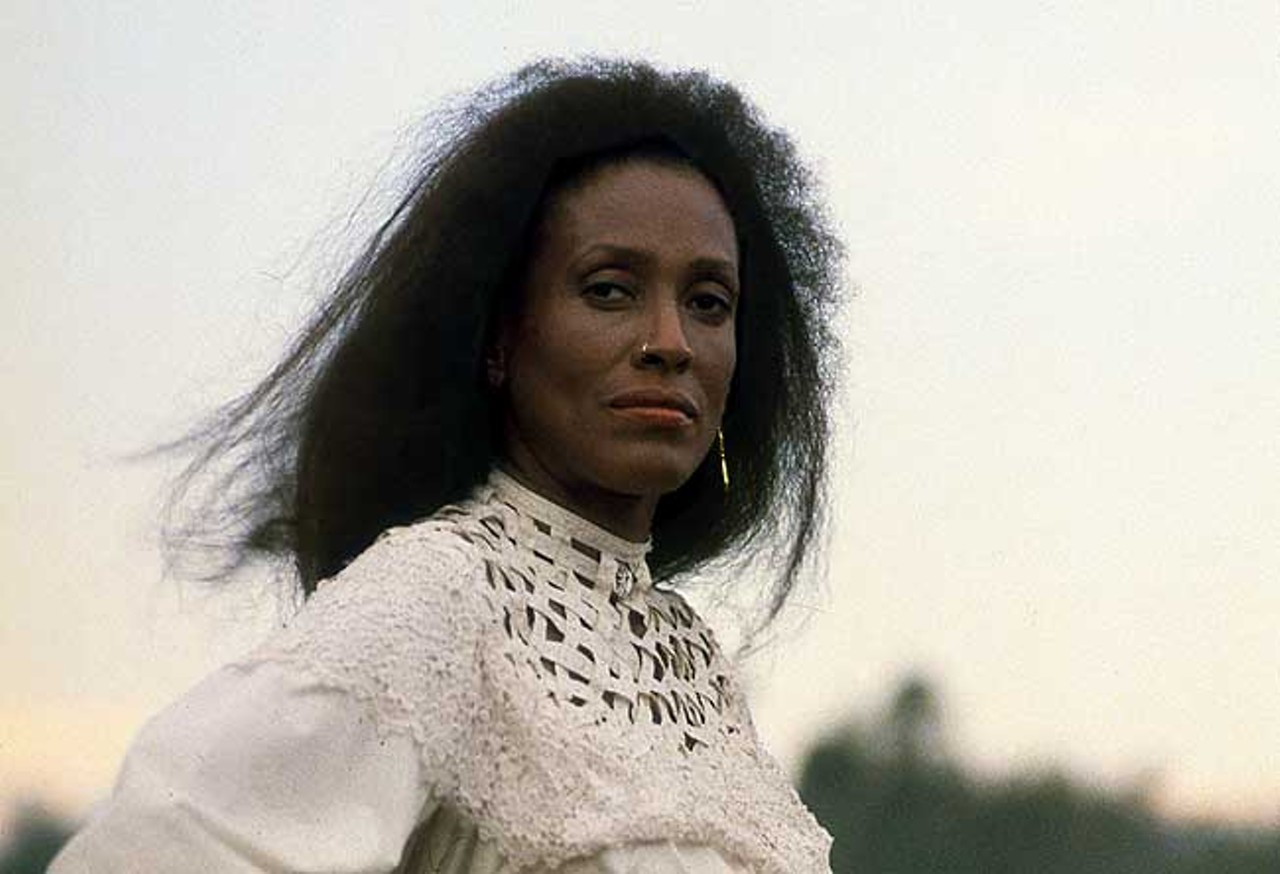
Image Courtesy of Charleston City Paper, Julie Dash – Yellow Mary, another ruin’t woman, is greeted coldly by the Peazant family when she returns to the island
One individual integral to the process of developing a space that authentically mirrored the lush landscape envisioned by Dash was Kerry James Marshall. The prolific painter uses paint, sculpture, multi-media installations, photography, and collage to transpose purposefully black figures onto idyllic backdrops and sequences of action. Marshall often reimagines the work of classical painters with black subjects at the forefront.
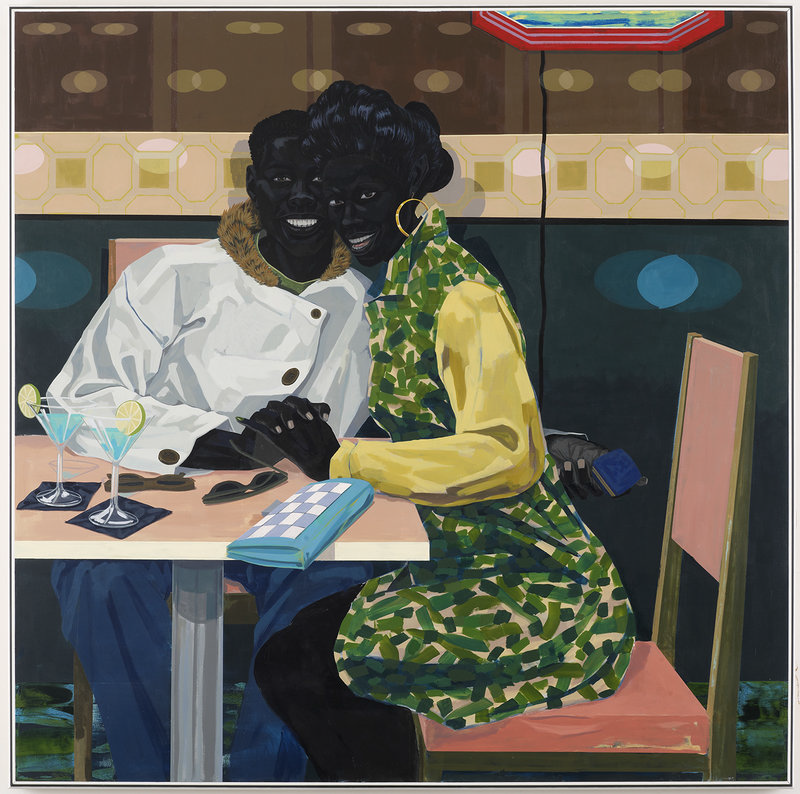
Untitled (Club Couple). Image Courtesy of The Museum of Contemporary Art, NPR
Marshall lent his gifts to Dash’s production in the form of set design, constructing the dye beds and family heirlooms that create the universe of the Peazant clan, take, for instance, Nana Peazant’s chair. Marshall also did the set design for Haile Gerima’s 1993 film Sankofa.
Link 3: Here is a brief interview Kerry James Marshall conducted on the “liberating function” of being a black artist:
Link 4: Here is a more recent interview in which Marshall talks with the Chicago Museum of Contemporary Art on his most recent body of work, Mastry: https://www.youtube.com/watch?v=K2bmHE7MRQU&t=46s
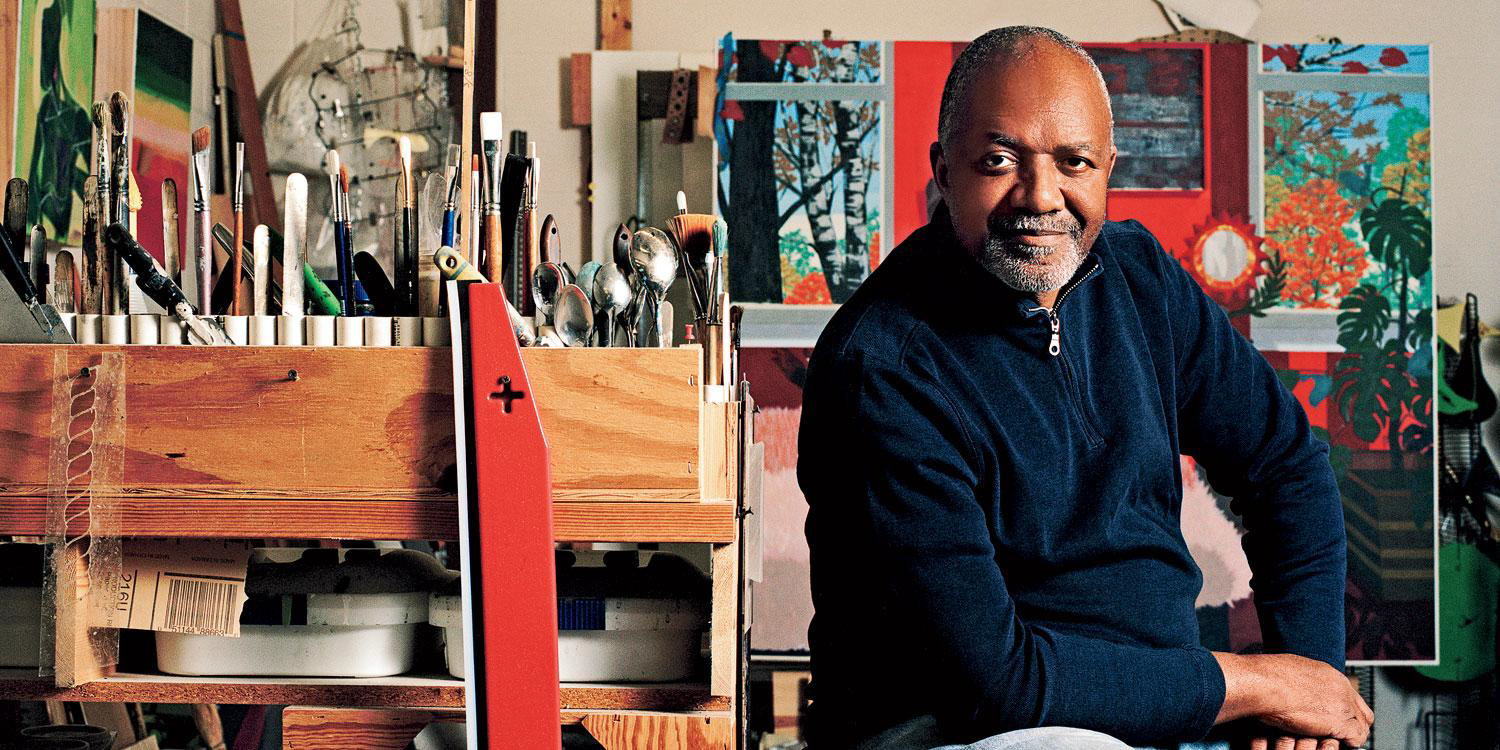
Kerry James Marshall, Image Courtesy of Dawoud Bey, Chicago Magazine
Michael Kelly Williams and Martha Jackson- Jarvis rounded out Dash’s art department, with Kelly Williams operating as the art designer. Kelly-Williams, an Afro-French artist specializing in sculpture, printmaking, and paint, has worked for decades on abstract art. He has studied extensively in New York and D.C. and was the Artist in Residence at the Studio Museum in Harlem. Kelly Williams’s art has been exhibited across the United States in places like the Schomburg in New York and The Library of Congress in D.C.
Martha Jackson Jarvis is a sculptor specializing in nature based work as well as three dimensional works on paper. Jarvis studied mosaic techniques and stone cutting in Ravenna,
Reach for a Star, Michael Kelly Williams. Image Courtesy of New York City Department of Cultural Affairs
Italy, and among other awards, she has been awarded a fellowship from the National Endowment of the Arts. Her work has been exhibited in galleries across the United States, including the Studio Museum of Harlem, and the Corcoran Gallery of Art in Washington, D.C, to name a few. Seemingly, Daughters of the Dust is the only art design credit for both Jarvis and Kelly- Williams.
Link 5: Here is a clip of Martha Jackson Jarvis discussing her work:

Ancestors’ Bones/ Nest Stones, Installation, Martha Jackson Jarvis. Image Courtesy of MarthaJacksonJarvis.com
Julie Dash recalled working with Marshall, Williams, Jarvis, and her then husband, cinematographer Arthur Jafa in a 2016 interview. “It was collaborative. And back then, Arthur Jafa talked about it as a jazz band, like a jazz orchestra out there. Working with [production designer] Kerry James Marshall and [art director] Michael Kelly Williams and the costume designers—it just started flowing. It was a huge production for an independent film. We had these big warehouses where we had the costumes stored, where they were being dyed. The art department had their warehouse where Michael Kelly Williams was making the chair and he and Kerry were making the tombstones and the figureheads. It was a museum, if you will, walking through the art department…Kerry actually built those indigo dyeing mounds, all based upon what we could find or pull together or read about how they did it in West Africa as the foundation for what was done here. I believe we were the very first ever to have indigo as a visual theme or motif that went throughout the story. I decided, instead of showing the form of enslaved people with whip marks or scars of slavery, their scars would be the permanent blue hands from working the indigo fields, and that’s how you could tell who was a former enslaved person of the elders” (De Costa).
Each member of the production department and art department seemed to invest artistically in Dash’s vision in a very specific way. Dash did not simply choose an art designer who had worked on other “black” projects, or a production designer who was popular in Hollywood, she stayed true to the facets of the LA Rebellion and instead chose to work with people who could execute on her vision with a level of specificity that was needed to make her film memorable.
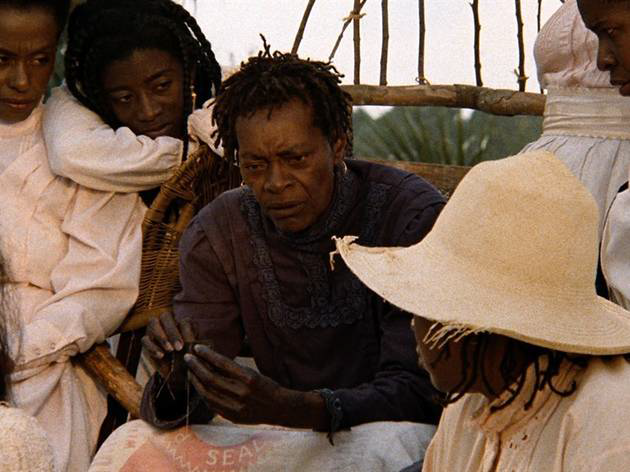
Image Courtesy of Cohen Media Group
Other artifacts that helped make Daughters memorable were the hairstyles featured in the film. Dash enlisted Pamela Farrell, founder of D.C. based haircare company Cornrows and Company as the hair specialist for her film. Farrell made sure to remain authentic by showcasing the fact that black women in the early 20th century did adorn themselves and their natural hair. When discussing her decision to work with Farrell, Dash recollected her time as an AFI intern on the 1977 mini-series, Roots. “I remember asking the makeup/hair person, ‘Why do you have their hair pressed and braids [in their hair like that]. Sort of like a Danish or Swedish hairstyle. She told me, ‘Well they were trying to do their hair like the mistress of master’s house.’ The world view is just myopic. That’s why I hired Pamela Farrell of Cornrows & Company out of DC. She came down with her team and recreated these ancient hairstyles and kept them done and refreshed” (Bastien). Here again, is an instance in which Julie Dash and her team emphasized authenticity and cultural specificity in choosing who to work with. Farrell and her company had the ability to execute on a cultural idiosyncrasy because of her true to life dedication to nurturing and celebrating generations of natural hair- one that is still ongoing.
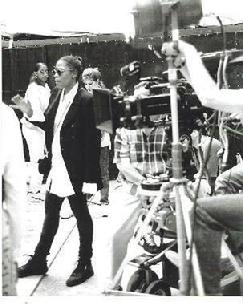
Image Courtesy of Arline, Inc.
In addition to a celebration of natural hairstyles, costumes also played a large part in constructing the iconic universe of Daughters of the Dust. Dash worked with Arline Burks Gant as the head of the costume department. Gant and Dash chose specifically to place some of the women in delicate white dresses to emphasize the importance of this occasion for them; an occasion of visitors and a day of feasting. Dash also dated the clothes to look “ten to fifteen years older than 1902 so we could see that they were hand me downs and old things” (Bastien). Gant, a writer- director in her own right, would later go on to do costume design for Bill Duke in his 1992 film Deep Cover and the hit television show Martin. Julie Dash also helped a bit with costume herself, as director.
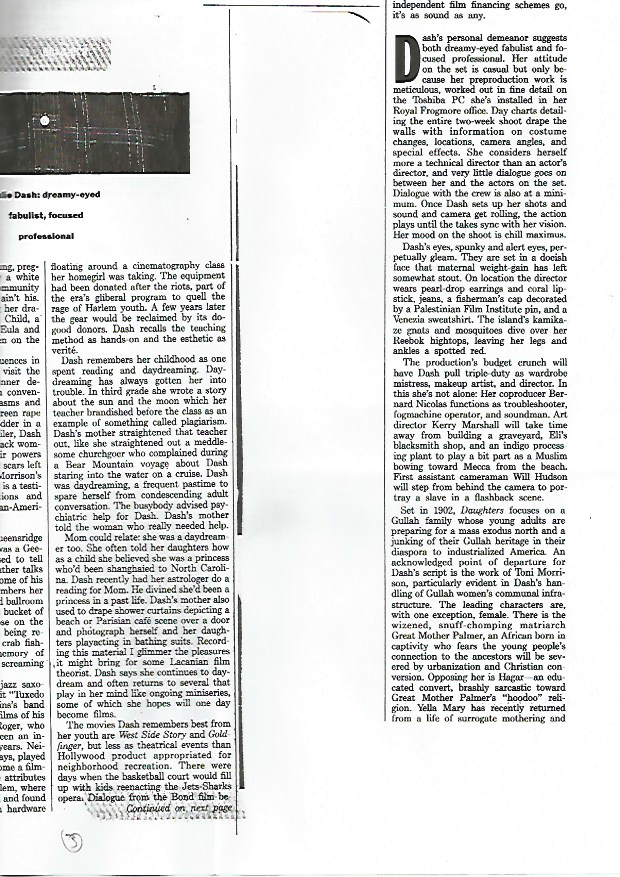
Scanned Document 2: Excerpt, Greg Tate’s 1988 Village Voice Article. Image Courtesy of the Margaret Herrick Library Reference and Research Collection, 2016
In a 1988 Village Voice article, Greg Tate recalls visiting the set and witnessing crew dynamics in real time. Many crew members, including Kerry James Marshall, and Julie Dash herself “double-dipped” into roles outside of their creative jurisdiction. Marshall performed a brief cameo as a bowing Muslim man, praying on the beach. Dash, wore many hats, including director, costume artist, and makeup artist. “The production’s budget crunch will have Dash pull triple duty as wardrobe mistress, makeup artist, and director” (Tate). This collaboration, although influenced by budgetary concerns, is true to the collectivism already outlined in the mission of the LA Rebellion.
Despite the collectivism and hard work of her team of dedicated artists and image makers, Dash was still criticized for the overall feel of her film, namely for rejecting conventional western story structure. The film has an undoubtedly foreign aesthetic, as it was meant to. For Dash, her creative choices were a form of protest, of bravado even, demonstrating with what ease she was able to break away from the fragile, normative western modes of story and image. Dash, instead, opted to allow her story to unfold in a series of pastiches, not unlike the rhythm of a village griot, an aim Dash made clear in interviews time and time again.
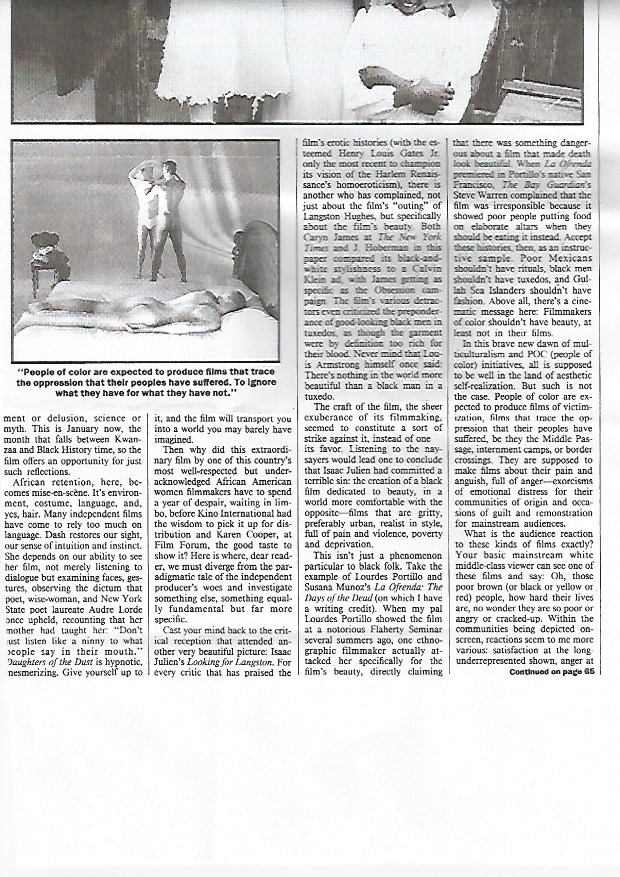
Scanned Document 3: Excerpt, Ruby Rich’s 1992 Village Voice Article. Image Courtesy of the Margaret Herrick Library Reference and Research Collection, 2016
Ruby Rich and other critics noticed the backlash taking place at the time of Daughters’ release. In her 1992 article, Rich compared the reception of Dash’s film to that of Isaac Julien’s 1989 film Looking for Langston which was equally languid and indulged viewers with a black and white aesthetic. Similar negative attention was given to Lourdes Portillo and Susana Munoz’s 1989 film La Ofrenda: The Days of the Dead. Critics bemoaned all three films as overly indulgent in their aesthetic and pacing to which Rich responded, “poor Mexicans shouldn’t have rituals, black men shouldn’t have tuxedos, and Gullah Sea Islanders shouldn’t have fashion. Above all, there’s a cinematic message here: Filmmakers of color shouldn’t have beauty, at least not in their films” (Rich, Village Voice). Dash’s work and creative choices are a testament to what happens when image makers refuse to stay inside the boxes and discrete categories allotted them. Despite blatant discrimination, her message thrives.
Dash had a team of immensely talented artists and storytellers on board to help enrich this milestone of a film and on the heels of Beyoncé’s Lemonade, a visual album that pays enormous tribute to the weeping willows, rolling landscapes, and statuesque brown women adorned in delicate white lace found in Dash’s Daughters, more and more voices seem to be joining the conversation on unconventional representations of black art. Ahead of Lemonade, Daughters of the Dust was already in the works to be restored by Charles Cohen’s distribution company. The 25th anniversary restoration and subsequent theatrical release are finally pressing Daughters of the Dust back into the public discourses. As Roger Ebert said in the spring of 1992, “by word of mouth it is attracting steadily growing audiences…people tell each other about it” (Ebert).
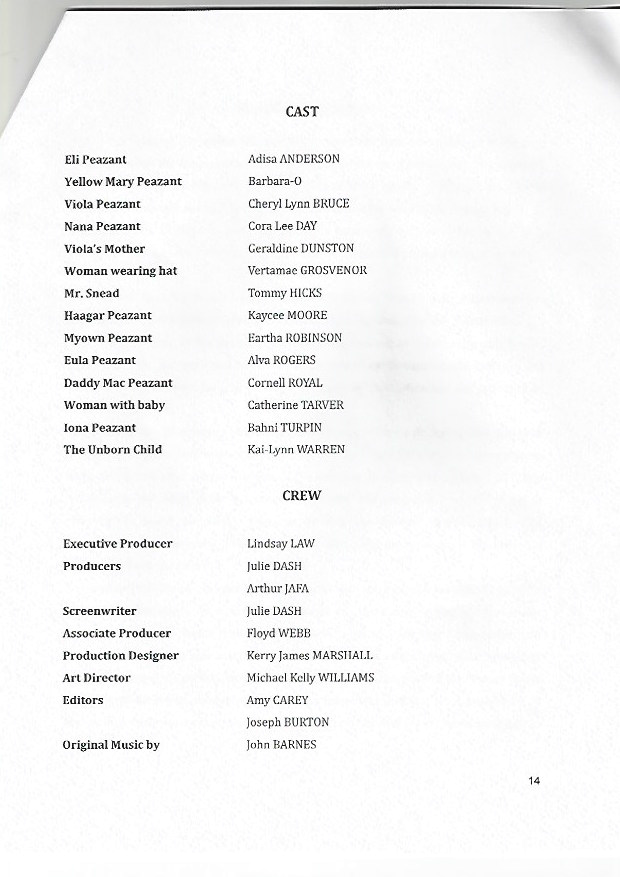
Scanned Document 4: Cohen Media Group Press Materials, Final Cast and Crew List. Image Courtesy of the Margaret Herrick Library Reference and Research Collection, 2016
The audience that is consuming Dash’s Daughters of the Dust is still steadily growing. Narratively, production wise, and even in terms of the budget, Julie Dash made choices that will influence the ways in which others create and consume forever. Perhaps this is the end of artists being “ahead of their time.” The very notion of being ahead of one’s time implies some sort of existential miscalculation on the part of the artist. On the contrary, Daughters of the Dust was not ahead of its time, rather, it disrupted a pleasant and predictable culture of filmmaking and in disrupting it, breathed new life into the age old tradition of telling a story.
Julie Dash’s relevant filmography:
- Working Models of Success (Documentary, 1973) A promotional documentary for the New York Urban Coalition Dash produced while a student.
- Four Women (Short, 1975) The film focuses on one dancer, Linda Martina Young as she performs to Nina Simone’s Four Women. Here is a link to the film: https://vimeo.com/74869216
- Diary of an African Nun (Short, 1977)- a short Dash filmed while still a student, the film was based on a short story written by Angela Davis. Dash sent a copy to Davis only to receive a scathing review from the activist. The film won her a student award from the Director’s Guild of America.
- Illusions (Short, 1982). – a short Dash filmed while a student at UCLA. The film focuses on racial disparities in the film industry and one woman’s attempt to navigate it all through passing and subsequently infiltrating the industry for black people. Dash was met with resistance from some, who compared the film to Douglas Sirk’s Imitation of Life.
- Daughters of the Dust (Feature, 1991)
- Funny Valentines (1999) In this film, Dash tells the story of a woman who escapes a loveless marriage and returns to her southern roots.
- Incognito (TV Movie, 1999) In this 1999 TV movie starring Allison Jones and Michael T. Williams, a young socialite enlists a bodyguard to keep her safe after a stalker poses trouble
- Love Song (TV Movie, 2000) An African American college student falls in love with a white musician.
- The Rosa Parks Story (TV Movie, 2002) A film starring Angela Bassett that follows the life of the civil rights icon.
- Travel Notes of a Geechee Girl (Documentary, 2017) A documentary following the life of writer, culinary anthropologist and actress Vertamae Smart Grosvenor. http://travelnotesofageecheegirl.com
Source: International Movie Database, UCLA Film and Television Archive
Bibliography
Bastien, Angelica Jade. “We Have a Lifetime of Stories to Tell: Julie Dash on ‘Daughters of the Dust.’” Roger Ebert Interviews. Mar 27 2017. http://www.rogerebert.com/interviews/we-have-a-lifetime-of-stories-to-tell-julie-dash-on-daughters-of-the-dust. Accessed 27 Mar 2017
Bey, Dawoud. Chicago Magazine. Mar 29 2016. http://www.chicagomag.com/Chicago-Magazine/April-2016/Kerry-James-Marshall/. Accessed Mar 26 2017.
Buckley, Cara. “Julie Dash Made a Movie. Then Hollywood Shut Her Out.” The New York Times. 18 Nov 2016. https://www.nytimes.com/2016/11/20/movies/julie-dash-daughters-of-the-dust.html?_r=0. Accessed 9 Feb 2017.
“City Sun Critic Trashes ‘Daughters of the Dust’.” New York Amsterdam News (1962-1993), Feb 01 1992, pp. 22. ProQuest Historical Newspapers: New York Amsterdam News, https://search.proquest.com/docview/226215240?accountid=14512.
Cohen Media Group. “Daughters of the Dust Press Release Materials.” Margaret Herrick Library Reference and Research Collection, 2016. Print.
Cohen Media Group. Image Gallery. Chen Media Group. 2017 http://www.cohenmedia.net/films/daughters-of-the-dust. Accessed Mar 16 2017.
Collins, Kathleen. “Biography.” KathleenCollins.Org. Nina Lorez Collins, 2016. http://kathleencollins.org/about/. Accessed 10 Feb 2017.
Coyle, Jake. “Julie Dash’s Landmark ‘Daughters of the Dust’ is Reborn.” The Seattle Times. 18 Nov 2016. http://www.seattletimes.com/nation-world/julie-dashs-landmark-daughters-of-the-dust-is-reborn/. Accessed 10 Feb 2017.
Dash, Julie. JulieDash.tv Image. 2011. http://juliedash.tv/blog3/. Accessed 25 Mar 2017
Dash, Julie. “Yellow Mary.” Sept 14 2011. http://www.charlestoncitypaper.com/charleston/twenty-years-later-julie-dashs-film-daughters-of-the-dust-continues-to-inspire/Content?oid=3582660 . Accessed 20 Mar 2017.
De Costa, Cassie. “Interview: Julie Dash.” Film Comment. Feb 29 2016. https://www.filmcomment.com/blog/interview-julie-dash/. Accessed 25 Mar 2017.
Ebert, Roger. “Daughters of the Dust.” RogerEbert.Com. 13 Mar 1992. http://www.rogerebert.com/reviews/daughters-of-the-dust-1992. Accessed 9 Feb 2017.
Fox, David J. “A Slimmer Year for Black Films : Movies: Some Blame the Industry, Others Say the Major Black Filmmakers Are Working on ’93 Films. Los Angeles Times. 17 Aug 1992. http://articles.latimes.com/1992-08-17/entertainment/ca-5130_1_black-films. Accessed 9 Feb 2017.
Gant, Arline Burks. “Arline Burks Gant.” Arline, Inc. http://arlineinc.com/aboutus/arlineburksgant.html. Accessed 23 Mar 2017.
Grierson, Tim. “’Daughters of the Dust’: Why the Movie That Inspired ‘Lemonade’ Is Back.” Rolling Stone. Nov 18 2016. http://www.rollingstone.com/movies/features/why-we-need-indie-movie-daughters-of-the-dust-right-now-w450955 . Accessed 22 Mar 2017.
Holden, Stephen. “‘Daughters of the Dust’: The Demise of a Tradition.” New York Times (1923-Current file), Jan 16 1992, pp. 2. ProQuest Historical Newspapers: The New York Times, https://search.proquest.com/docview/108860011?accountid=14512.
Ivory, Mable. “’90s Film ‘Daughters of the Dust’ Returns To Theaters to Mesmerize & Inspire A New Generation.” Essence. 7 Dec 2016. http://www.essence.com/culture/daughters-of-the-dust-returns-theaters. Accessed 10 Feb 2017.
Jarvis, Martha Jackson. “Biography.” Martha Jackson Jarvis Studio, 2017. Web. http://marthajacksonjarvis.com/biography . Accessed 23 Mar 2017.
Jarvis, Martha Jackson. “Ancestors’ Bones/ Nest Stones.” Martha Jackson Jarvis Studio, 2017. Web. http://marthajacksonjarvis.com/studio-works-2/.html . Accessed 23 Mar 2017.
Keeling, Kara. “In Order to Move Forward: Common-Sense Black Nationalism and Haile Gerima’s Sankofa.” The Witch’s Flight. 45-67. Duke University Press. Durham, 2007. Print.
KENNETH TURAN TIMES, FILM C. “‘Daughters of Dust’ Recaptures the Power of Gullah Culture.” Los Angeles Times (1923-Current File), Apr 09 1992, pp. 2. ProQuest Historical Newspapers: Los Angeles Times, https://search.proquest.com/docview/1730272364?accountid=14512.
“Kerry James Marshall: Being an Artist | Art21 ‘Exclusive.'” YouTube, uploaded by Art21, 8 Jul 2008, https://www.youtube.com/watch?v=hwcldfebtVs.
“Kerry James Marshall: Mastry.” YouTube, uploaded by Museum of Contemporary Art Chicago, 2 May 2016, https://www.youtube.com/watch?v=K2bmHE7MRQU&t=46s.
“The Making of the Daughters of the Dust/ Julie Dash and Cast.” YouTube, uploaded by Afrikanliberation, 7 Mar 2012, https://www.youtube.com/watch?v=mqT0mcBLdmc.
Marshall, Kerry James. “Untitled (Club Couple).” NPR. 2017. http://www.npr.org/2017/03/28/521683667/kerry-james-marshall-a-black-presence-in-the-art-world-is-not-negotiable. Accessed Mar 23 2017.
Mims, Sergio. “WATCH MELISSA HARRIS-PERRY INTERVIEW JULIE DASH ABOUT ‘DAUGHTERS OF THE DUST,’ FILMMAKING & MORE.” Shadow and Act. 2 Jan 2017. http://shadowandact.com/2017/01/02/watch-melissa-harris-perry-interview-julie-dash-about-daughters-of-the-dust-and-other-things/. Accessed 9 Feb 2017.
“Public Art by Martha Jackson-Jarvis.” YouTube, uploaded by Jeannette Glover, 1 Aug 2013, https://www.youtube.com/watch?v=hNDNEMLEe4g.
Rich, Ruby. “In the Eyes of the Beholder.” Village Voice. Jan 28 1992. Print.
Tate, Greg. “Favorite Daughters: Julie Dash Films Gullah Country.” Village Voice. April 12 1988. Print.
UCLA Film and Television Archive. L.A. Rebellion: Julie Dash, 2014. https://www.cinema.ucla.edu/la-rebellion/julie-dash. Accessed 23 Mar 2017.
Walker, John. “Ava DuVernay Says This Glass Ceiling She Broke Should’ve Been Shattered ‘a Long Time Ago.’” Fusion. 5 Aug 2016. http://fusion.net/story/333864/ava-duvernay-first-woman-of-color-director-100-million-dollar-film/. Accessed 10 Feb 2017.
Williams, Michael Kelly. “About.” Michael Kelly Williams: Artist. WordPress. Web. https://michaelkellywilliams.com . Accessed 23 Mar 2017.
Williams, Michael Kelly. “Reach for a Star.” New York City Department of Cultural Affairs. The City of New York. 2017. http://www.nyc.gov/html/dcla/html/panyc/williams.shtml . Accessed 25 Mar 2017.
Recent Comments